Keep Your Child Healthy this Back to School Season
Backpacks, pencils, books, new clothes, sack lunches…it’s that time of year again when kids go back to school and our routines change. In all the hustle and bustle of change, stress, and excitement, we sometimes forget the simple things that help our children stay healthy and happy. Backpacks, helmets, nutrition, sleep, and posture are all things that affect a child’s health, mood, and their ability to effectively learn. These essential tips can help you ensure your child has the back-to-school wellness support they need to stay healthy.
Backpacks
The American Chiropractic Association recommends a backpack weigh no more than 10 percent of a child’s weight. Unfortunately, it has become common to see children with backpacks that are as much as a quarter of their body weight.
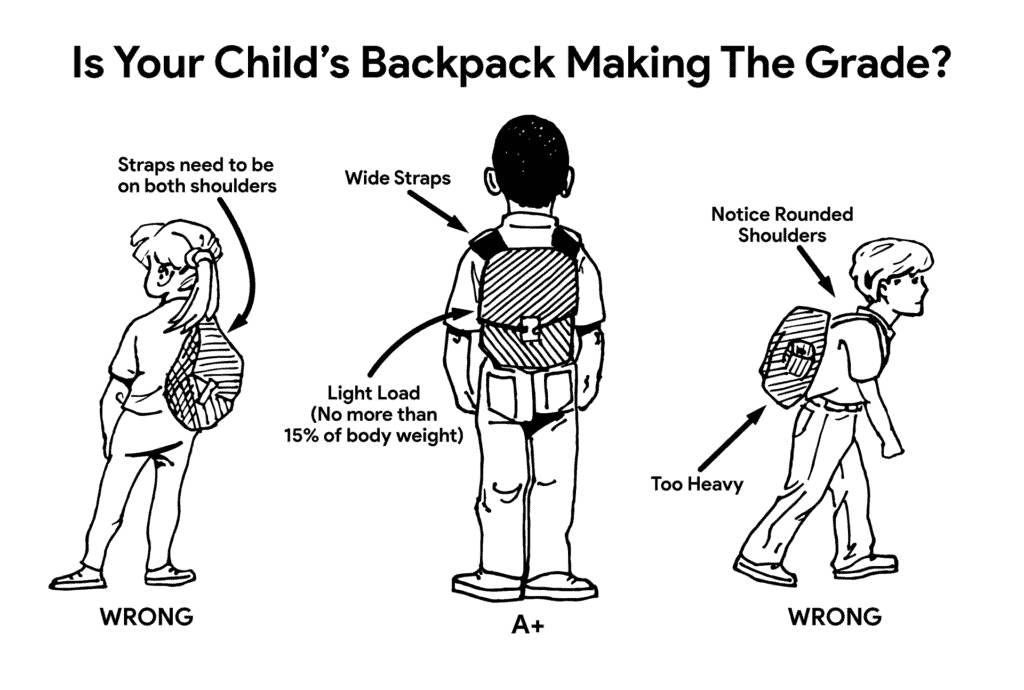
8 Backpack Tips for Better Posture
A properly fitted backpack is just one part of helping children maintain healthy posture and movement habits as they grow. Since kids are constantly developing, building awareness around alignment, mobility, and daily habits can play an important role in supporting their overall wellness. Beyond everyday posture tips, many families also explore chiropractic support for growing kids as a way to promote healthy nervous system function and help their bodies adapt through important stages of growth and activity.
1. Size
Backpacks should never be wider or longer than your child’s torso, and never hang more than 4 inches below the waist.
2. Hip and chest belts
Use a backpack with hip and chest belts to help transfer some of the weight off the spine to the hips and torso.
3. Always use both shoulder straps (ideally padded)
Slinging a backpack over one shoulder can strain muscles and throw off the alignment of the spine. Wearing a backpack on one shoulder may cause pain and problems in the back by misaligning the curvature of the spine. Be sure to always use both straps when wearing a backpack.
4. Pack Light
Backpack should never weigh more than 10 to 20 percent of the their total body weight.
5. Organize the backpack to use all of its compartments
Pack heavier items closest to the center of the back, smaller, lighter items in the outside compartments.
6. Stop often at school lockers
If possible. Do not carry all of the books needed for the day at once.
7. Bend using both knees
When you bend down. Do not bend over at the waist when wearing or lifting a heavy backpack.
8. Learn back-strengthening exercises
Learn back-strengthening exercises exercises to build up the muscles used to carry a backpack.
* Encourage your child or teenager to tell you about pain or discomfort that may be caused by a heavy backpack. Do not ignore any back pain in a child or teenager.
Helmets
Helmets should always be used for activities involving bikes, skateboards, scooters, longboards, roller blades, etc. Always wear a helmet to protect your head, no matter how short or long the ride.
Helmets come in a variety of sizes and shapes. They are the most effective way to prevent head injuries when riding bicycles, skateboard, scooters, etc. Ensuring a well and properly fitting helmet for your child increases its effectiveness in the event of a crash.
Everyone—adult and child—should wear bicycle helmets every time they ride. Wearing a helmet each ride can encourage the same smart behavior in others.
How to properly fit and wear a helmet
Step 1: Size
Measure your head for approximate size. Make sure the size of your child’s head matches the size the helmet is made for. “Buy a helmet that fits your head now, not a helmet to “grow into.”
Step 2: Position
The helmet should sit level on your head and low on your forehead—one or two finger-widths above your eyebrow.
Step 3: Buckles
Center the left buckle under the chin.
Step 4: Side Straps
Straps should be buckled snugly; tight enough to keep the helmet centered but not so tight as to cut off circulation.
Step 5: Chin Straps
Buckle your chin strap. Tighten the strap until it is snug, so that no more than one or two fingers fit under the strap.
Step 6: Final Fitting
Open your mouth and move your head side-to-side. If the helmet rocks forward onto your eyes or back further than two fingers above your eyebrows you will need to tighten and readjust the straps accordingly.
Posture
Teaching children about proper posture may keep them free of future backache. Research has shown that “The level of knowledge and motor skills in [an] experimental group showed a significant increase immediately.”
Proper Posture
While sitting, shoulders should be back, the core should be engaged and the spine should be straight, hovering close to the back of your chair. Do not rotate or lean sideways with your hips or head. Avoid sitting with legs crossed.
Focusing on childhood posture and nervous system health can help produce more energy and higher brain function because you use your body more efficiently. “When walking and sitting with good posture your muscles and bones are strengthened,” this allows for better alignment and longer holding.
childhood posture and nervous system health
Sources:
Lloyd-Jones, D., Adams, R. J., & Brown, T. M. (2010). Health Benefits of Hiking. Circulation, 121, e1-e170.
Mendez FJ, Gomez-Conesa A. Postural hygiene program to prevent low back pain, Spine. 2001 (Jun 1); 26 (11): 1280-1286
Additional Tips
Here are some additional tips to a healthier and happier lifestyle for you and your children whether at home, at school, or on the run somewhere in between. Believe it or not- these are all related to the care we offer at Sound Corrections Chiropractic.
Studying
Homework is another aspect of school that we would love to help you with. Take steps to help alleviate eye fatigue, neck fatigue and brain fatigue while studying. It may be helpful to close the books for a few minutes, stretch, and take a break periodically when it will not be too disruptive.
When studying be aware of your posture. Sit up straight and do not crane your neck down towards your lap or the table. Place reading materials at eye level so the neck is not strained and sit at a desk or table rather than sitting on a bed or the floor.
Drink lots of water
Stay hydrated! This allows your brain to function properly and your body to respond effectively. If your body is dehydrated it cannot begin to heal itself and hold the correction you receive when you come in for care.
Exercise
Recess or gym is a great time for your kids to get some exercise. Bring them in to see us periodically for a checkup to make sure they are staying aligned so they can continue to play and grow up happily, and continue to develop healthy habits for modern children.
Nutrition
Drink plenty of water and eat less junk food to keep muscles ready for recess activities or after school sports. Studies show that children who eat a nutritious breakfast function better. They do better in school, and have better concentration and more energy.
Sleep
Establish a good sleep routine. Insufficient sleep is associated with lower academic achievement in middle school, high school and college, as well as higher rates of absenteeism and tardiness. The optimal amount of sleep for most adolescents is in the range of 8.5 to 9.5 hours per night.
Use a proper pillow to sleep on and to prevent further misalignment and troubles. A proper pillow has neck support while lying on your back and side. When lying on your back your pillow should allow your head to lean back and not be pushed forward.
Common questions
Healthy routines can make a big difference during the school year. Encouraging good sleep habits, balanced meals, regular movement, proper hydration, and healthy posture habits can support a child’s overall wellness as they manage the demands of school and daily activities.
Yes. Carrying a backpack that is too heavy or worn incorrectly may place additional stress on the shoulders, neck, and back. Adjusting backpack straps properly, keeping the load manageable, and encouraging good posture habits can help support better comfort and movement.
Children spend many hours sitting, studying, using devices, and participating in activities that require repetitive positions. Supporting healthy posture and movement habits during growth can help promote better body awareness and overall function.
Some families explore pediatric chiropractic care as part of a broader approach to supporting their child’s overall wellness. At Sound Corrections Chiropractic, gentle techniques are used to support proper movement, nervous system function, and age-appropriate care for growing bodies.
Parents may consider an evaluation if their child experiences recurring discomfort, posture concerns, activity-related stress, or they simply want to support healthy development. A personalized consultation can help determine whether chiropractic care is appropriate for their needs.
Support Your Child’s Health This School Year
A healthy school year starts with a strong foundation. At Sound Corrections Chiropractic, we provide gentle pediatric chiropractic care designed to support children’s growth, development, nervous system function, and overall wellness.
Whether your child is dealing with stress, posture concerns, recurring discomfort, or you simply want to support their health proactively, our team is here to help.
Get Pediatric Care Today