
Archive page
Be Smart With Your Smartphone and Look Up!
As students worldwide return to school, it’s likely many will be e-learning in some capacity for hours each day on their digital devices. While our devices can be fantastic tools for entertainment and education, the postural effects are something all parents should be aware of. For many students, e-learning may increase neck, mid-back, and low back pain.
How Digital Devices Can Affect Your Health
Spending 6 or more hours each day looking down at your digital devices can profoundly affect your mental, social, and physical health. It can also lead to the development of “Tech Neck Syndrome.” This forward head posture often places tremendous stress on the neck (cervical spine) and can lead to an uptick in headaches, back and neck pain, and more.
- Low back pain is the 3rd most common form of pain interfering with schoolwork
- It's estimated that 50.3% of school-aged children present with posture disorders
- In fact, approximately 6% of children experience back pain from prolonged sitting
Making it a habit to look up (literally!) throughout the day is a significant first step in reducing the effects of “Tech Neck.” Try this: Pull your chin back, stretch your arms out in front of you, open them wide, then look up toward the ceiling and hold for 20–30 seconds. Repeat this stretch every 60 minutes to help reset your posture and body position. If your child spends much of the day learning on a computer, teach them this stretch and encourage other healthy routines for school-age children that promote movement, posture, and regular activity throughout the day. You can also schedule a visit with our practice for a comprehensive postural and movement-based assessment to identify potential issues and help reduce their risk of developing Tech Neck Syndrome.
Why Chiropractic Care is Critical for Kids Who Play Sports
Youth sports are a big deal. It’s estimated that over 45 million kids are actively engaged in sports! While sports give kids a fantastic opportunity to grow socially and physically, they also increase risks for injuries, pain from overuse, and muscular imbalances. Finding proactive ways to reduce the risk of injury and balance the effects of training are essential for your child’s developing musculoskeletal system.
Ensure Proper Musculoskeletal Development
Your child’s skeletal system is actively developing until they are approximately 25 years old. Their postural habits, history of injuries, and genetics play a role in their body’s final form (and function). Sports have the potential to add a significant amount of stress and increase the chances of injuries for your developing child. Even small injuries to their spine can create bigger challenges down the road as they get older.
- Addressing minor injuries and challenges while your child is young can help ensure proper musculoskeletal development
- Youth sports can increase your child's likelihood of developing overuse, growth plate injuries, and chronic pain
- Chiropractic care is a safe and natural way to help your child stay active and perform their best
Remember, don’t shrug it off if your child complains of back pain, headaches, or a stiff neck. Pain is your body’s way of saying, “Pay Attention Inside Now.” As screen time and digital learning continue to increase, many families are noticing technology-related stress in children that can affect posture, movement, and overall comfort. Our practitioners are experienced at evaluating growing bodies and creating personalized care plans designed to help children stay active, healthy, and engaged in the sports and activities they love.
Power Your Child’s Brain with Movement
Years ago, many believed that the health benefits of exercise were limited to the body. However, research has demonstrated that regular physical activity and movement can benefit both the body and the brain. Recent studies have highlighted that movement can improve the supply of oxygen to the brain and promote the production of new cells. In fact, it appears movement also aids in creating new connections in the brain!
The Benefits of Daily Movement
Many schools have reduced physical education classes. Many more students have moved towards e-learning. For those reasons, it’s important to be mindful of our children’s physical activity and to encourage them to exercise more each day. And not just to benefit their physical health. In many ways, exercising each day is likely to make your child a better student! Movement triggers the release of chemical substances in the brain that enhance brain function.
-
Better Brain Function
Movement may protect your brain against degenerative changes
-
Better Stress Reduction
Exercise and movement have been shown to have an antidepressant effect that can help reduce overall stress
-
Better Memory
Regular exercise can help directly and indirectly improve recall and reasoning skills

The research is clear—daily movement and exercise are beneficial for both your child’s body and brain. Our posture and movement assessments are designed to identify abnormal movement patterns and evaluate screen posture and spinal alignment, helping your child move more comfortably, stay active, and perform their best both in and out of the classroom. If your child struggles to get enough exercise because of recurring aches, movement restrictions, or posture concerns, we hope you’ll consider scheduling an appointment with us. Our doors are open, and we’re here to help your family build healthy habits that last.
E-Learning: How to Avoid Tech Neck
Is your child connected to a phone, computer, or tablet during and after school? Think about it. Many of us aren’t more than an arm’s length from our phone at any time (even when we are sleeping). Spending time every day looking down at our devices can place a lot of stress on the supporting muscles of our neck and lead to an uptick in headaches. It’s a condition called “Tech Neck,” and it’s one of the most common causes of headaches and neck pain.
Don't Wait to Get Care
The countless hours per day kids often spend on phones and computers can significantly contribute to tension headaches. In fact, it’s estimated that kids spend up to 1,400 hours per year in the exact positions that are attributed to the development of “Tech Neck.” That’s not surprising. Recent research has also shown that even 15 degrees of forward head tilt can triple the weight of the head on the spine.
- "Tech Neck" is the term used to describe the symptoms of headaches, neck pain, and poor posture attributed to the forward head posture often associated with using your phone, tablet, and computer.
- Taking a break from our mobile devices every 15 minutes can help reduce the likelihood of developing recurring neck pain and headaches.
- Chiropractic care including adjustments and postural exercises can help decrease the pain and reverse the effects of "Tech Neck".
Keep it simple. Encourage your children to take regular movement breaks, stretch often, and develop healthy screen habits throughout the day. These small, consistent habits are some of the easiest ways to help prevent the posture and movement patterns that can contribute to “Tech Neck.” If your child begins experiencing recurring neck pain, headaches, or stiffness after spending long hours online, don’t ignore those signals. Our providers are experienced in evaluating growing bodies and creating personalized care plans that include pediatric nervous system support to encourage healthy movement, posture, and overall development. We’re here to help your family build lifelong habits that support healthy, active kids.
Common questions
The appropriate amount of screen time depends on a child’s age and individual needs. Most experts recommend balancing recreational screen time with regular physical activity, outdoor play, quality sleep, and face-to-face social interaction.
Yes. Spending long periods looking down at phones, tablets, or computers may contribute to poor posture, muscle tension, and movement restrictions over time. Encouraging frequent movement breaks and ergonomic habits can help reduce unnecessary strain.
Regular movement supports healthy muscle development, coordination, balance, cardiovascular health, and overall physical and emotional well-being. It also helps children develop lifelong healthy habits.
Many families choose chiropractic care as part of a proactive wellness approach. Gentle, age-appropriate chiropractic care may help support healthy movement, nervous system function, and overall physical development as children grow.
Parents often consider an evaluation if they notice changes in posture, recurring discomfort, sports-related injuries, movement concerns, or simply want to support their child’s overall health and development. Recommendations are always based on each child’s individual needs.
Help Your Child Build Healthy Habits for Life
Raising healthy, active children in today's digital world isn't about eliminating technology—it's about creating balance. Encouraging movement, limiting unnecessary screen time, supporting healthy posture, and developing consistent daily habits can make a meaningful difference in your child's overall well-being.
At Sound Corrections Chiropractic, we're passionate about helping children and families build healthy foundations through every stage of growth and development. If you have questions about your child's posture, movement, or overall wellness, we're here to help.
Ready to take the next step? Get Started with Care and discover how we can support your family's health.
Get Started With CareDo Children Need Chiropractic Care?
We are constantly looking for ways we can better ourselves as individuals and parents. Why not consider chiropractic care for your child? While many still associate chiropractors with adult care, there are many advantages of chiropractic care for children (both pediatric and adolescent) that can help support a healthy and pain-free journey to adulthood. Incorporating gentle pediatric chiropractic support into your child’s wellness routine can be a proactive step in supporting their growth, development, and overall well-being. So, let’s ensure our children and youth start their journey to adulthood on the right path – one where they experience the many benefits of chiropractic care.
A pediatric chiropractor is trained to look for the things that interfere with your child’s optimal function. At Sound Corrections Chiropractic we don’t just believe that your child has unlimited potential–our job is to unlock it. We use innovative new technology to gently correct misalignments without the use of harsh physical force or manipulation. Sound Corrections is one of only three ICPA-certified pediatric chiropractors in Utah County.
The Benefits of Pediatric Care
- Support healthier sleep patterns and overall rest
- Encourage healthy digestive function and comfort
- Promote healthy nervous system function
- Support focus, attention, and overall well-being
- Encourage healthy respiratory and immune system function
- Help support comfort related to digestive concerns in infants and children
- Promote healthy movement, posture, and physical development
- Support overall health, wellness, and resilience during growth
- Encourage healthy brain and nervous system development
Chiropractic Care for Children
As children grow and develop, they require a special kind of care and a gentler approach to wellness. Chiropractic care for children and youths at Sound Corrections is gentle and non-invasive. Our sound wave technology is gentle and non-invasive. Using laser precision to make the adjustment, patients can achieve higher and longer-lasting results. Our ICPA-certified pediatric chiropractors use age-appropriate techniques and keep up-to-date with the latest support for patients of all ages.
It is our mission to provide the best care and deliver individualized suggestions, while also considering the unique needs and health concerns of each child or adolescent. The early years of a child’s life are crucial for spinal development. Gentle low-force chiropractic adjustments offered by the doctors at Sound Corrections can help correct any misalignments that may arise due to birth trauma, falls, sports injuries, or postural issues. By ensuring that the spine is properly aligned, chiropractic care can contribute to a healthy foundation for a child’s physical development.

The Importance of Early Care
Childhood is a time for development and exploration. Early intervention is a key principle in chiropractic care for children. By addressing common childhood nervous system challenges early, chiropractors can help prevent problems from becoming more severe in adulthood. Additionally, the positive impact on a child’s nervous system can set the stage for a lifetime of good health and wellness. It’s better to grow healthy kids than to fix injured adults
Chiropractic adjustments can help ensure that the nervous system functions optimally in order to fulfill its pivotal role in adolescent development by relieving pressure on spinal nerves, opening up and strengthening connections, and improving communication between the brain and the rest of the body. This can enhance the child’s ability to adapt and respond to various stressors, both physical and emotional.
Adolescence often brings with it the challenges of poor posture, particularly due to increased screen time and heavier backpacks. Chiropractic care can help adolescents maintain good posture and address any postural issues early, reducing the risk of long-term problems like scoliosis.
Alignment Through the Stages
Part of growing and exploring means suffering the occasional fall, bump, bruise scrape, sickness, and general exposure to germs. A well-functioning immune system is crucial to help your children stay healthy. Chiropractic care may contribute to a stronger immune system by ensuring the spine and nervous system are in optimal condition. This can help the body respond more effectively to infections and illnesses. Our chiropractors at Sound Corrections are here to help realign children and youth through all manner of injuries, sports-related or from everyday play.
Giving your children the best also includes looking out for their mental and emotional well-being. Chiropractic care can help facilitate a more aligned body, ensuring that every part of the body is working in sync and without disruptions. Adolescence is a time of emotional and mental growth. Chiropractic care can help adolescents manage stress, anxiety, and emotional challenges by ensuring their nervous systems are functioning optimally, generating improved mental and emotional well-being.
From spinal health and improved nervous system function to enhanced immune support and stress management, chiropractic care can play a pivotal role in promoting a healthier and happier childhood and adolescence. Together, we want to help you and your family thrive. Make an appointment with our ICPA-certified pediatric chiropractors at Sound Corrections Chiropractic today.
Common questions
Pediatric chiropractic care uses gentle, age-appropriate techniques designed specifically for growing bodies. The approach is very different from the techniques used for adults and is tailored to each child’s age, size, and individual needs.
Children of many different ages—from infants to teenagers—may be evaluated depending on their health needs and family goals. Every child receives an individualized assessment to determine whether care is appropriate.
Families seek chiropractic care for many different reasons, including supporting healthy development, posture, movement, physical activity, and overall wellness. Some parents also choose regular wellness visits to help support their child’s growing body.
Many active children and teenagers place significant demands on their bodies through sports, recreation, and everyday activities. Chiropractic care may be included as part of a broader approach to supporting healthy movement, mobility, and recovery.
The first visit typically includes a discussion about your child’s health history, current concerns, and wellness goals, followed by an age-appropriate evaluation. If care is recommended, your provider will explain the findings and create a personalized plan based on your child’s individual needs.
Help Your Child Thrive Through Every Stage of Growth
As children grow, their bodies are constantly adapting to new activities, milestones, and everyday challenges. Whether your goal is to support healthy movement, address recurring discomfort, or simply encourage lifelong wellness, a personalized approach can help your child stay active and confident.
At Sound Corrections Chiropractic, we provide gentle, age-appropriate care designed around your child's unique needs and stage of development.
Ready to learn whether chiropractic care is right for your family? Get started with care today.
Get Started With CareKeep Your Child Healthy this Back to School Season
Backpacks, pencils, books, new clothes, sack lunches…it’s that time of year again when kids go back to school and our routines change. In all the hustle and bustle of change, stress, and excitement, we sometimes forget the simple things that help our children stay healthy and happy. Backpacks, helmets, nutrition, sleep, and posture are all things that affect a child’s health, mood, and their ability to effectively learn. These essential tips can help you ensure your child has the back-to-school wellness support they need to stay healthy.
Backpacks
The American Chiropractic Association recommends a backpack weigh no more than 10 percent of a child’s weight. Unfortunately, it has become common to see children with backpacks that are as much as a quarter of their body weight.
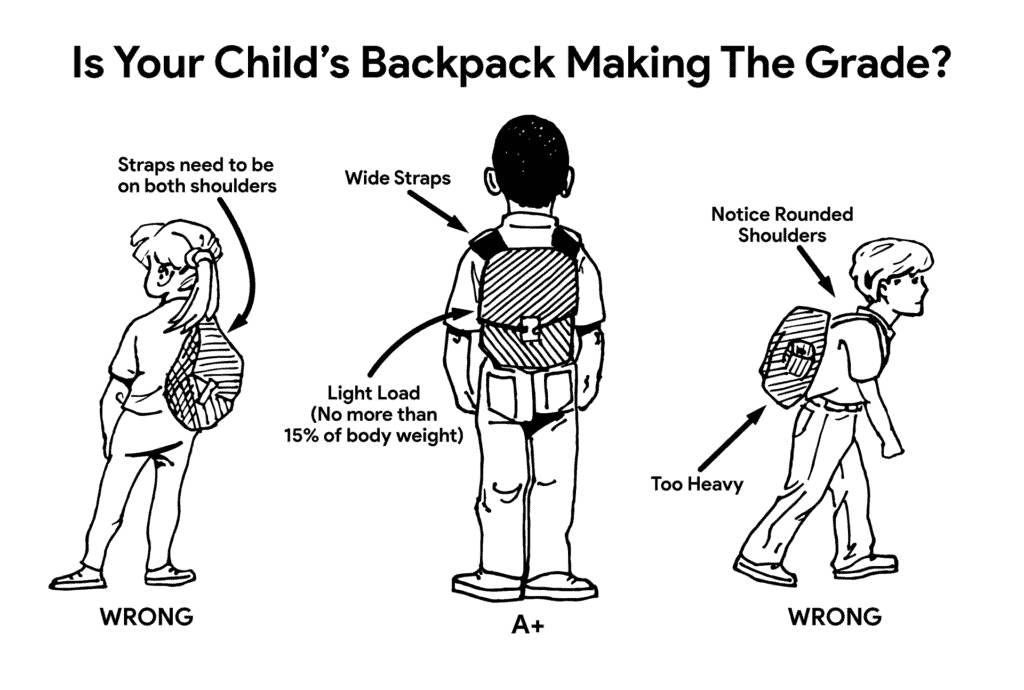
8 Backpack Tips for Better Posture
A properly fitted backpack is just one part of helping children maintain healthy posture and movement habits as they grow. Since kids are constantly developing, building awareness around alignment, mobility, and daily habits can play an important role in supporting their overall wellness. Beyond everyday posture tips, many families also explore chiropractic support for growing kids as a way to promote healthy nervous system function and help their bodies adapt through important stages of growth and activity.
1. Size
Backpacks should never be wider or longer than your child’s torso, and never hang more than 4 inches below the waist.
2. Hip and chest belts
Use a backpack with hip and chest belts to help transfer some of the weight off the spine to the hips and torso.
3. Always use both shoulder straps (ideally padded)
Slinging a backpack over one shoulder can strain muscles and throw off the alignment of the spine. Wearing a backpack on one shoulder may cause pain and problems in the back by misaligning the curvature of the spine. Be sure to always use both straps when wearing a backpack.
4. Pack Light
Backpack should never weigh more than 10 to 20 percent of the their total body weight.
5. Organize the backpack to use all of its compartments
Pack heavier items closest to the center of the back, smaller, lighter items in the outside compartments.
6. Stop often at school lockers
If possible. Do not carry all of the books needed for the day at once.
7. Bend using both knees
When you bend down. Do not bend over at the waist when wearing or lifting a heavy backpack.
8. Learn back-strengthening exercises
Learn back-strengthening exercises exercises to build up the muscles used to carry a backpack.
* Encourage your child or teenager to tell you about pain or discomfort that may be caused by a heavy backpack. Do not ignore any back pain in a child or teenager.
Helmets
Helmets should always be used for activities involving bikes, skateboards, scooters, longboards, roller blades, etc. Always wear a helmet to protect your head, no matter how short or long the ride.
Helmets come in a variety of sizes and shapes. They are the most effective way to prevent head injuries when riding bicycles, skateboard, scooters, etc. Ensuring a well and properly fitting helmet for your child increases its effectiveness in the event of a crash.
Everyone—adult and child—should wear bicycle helmets every time they ride. Wearing a helmet each ride can encourage the same smart behavior in others.
How to properly fit and wear a helmet
Step 1: Size
Measure your head for approximate size. Make sure the size of your child’s head matches the size the helmet is made for. “Buy a helmet that fits your head now, not a helmet to “grow into.”
Step 2: Position
The helmet should sit level on your head and low on your forehead—one or two finger-widths above your eyebrow.
Step 3: Buckles
Center the left buckle under the chin.
Step 4: Side Straps
Straps should be buckled snugly; tight enough to keep the helmet centered but not so tight as to cut off circulation.
Step 5: Chin Straps
Buckle your chin strap. Tighten the strap until it is snug, so that no more than one or two fingers fit under the strap.
Step 6: Final Fitting
Open your mouth and move your head side-to-side. If the helmet rocks forward onto your eyes or back further than two fingers above your eyebrows you will need to tighten and readjust the straps accordingly.
Posture
Teaching children about proper posture may keep them free of future backache. Research has shown that “The level of knowledge and motor skills in [an] experimental group showed a significant increase immediately.”
Proper Posture
While sitting, shoulders should be back, the core should be engaged and the spine should be straight, hovering close to the back of your chair. Do not rotate or lean sideways with your hips or head. Avoid sitting with legs crossed.
Focusing on childhood posture and nervous system health can help produce more energy and higher brain function because you use your body more efficiently. “When walking and sitting with good posture your muscles and bones are strengthened,” this allows for better alignment and longer holding.
childhood posture and nervous system health
Sources:
Lloyd-Jones, D., Adams, R. J., & Brown, T. M. (2010). Health Benefits of Hiking. Circulation, 121, e1-e170.
Mendez FJ, Gomez-Conesa A. Postural hygiene program to prevent low back pain, Spine. 2001 (Jun 1); 26 (11): 1280-1286
Additional Tips
Here are some additional tips to a healthier and happier lifestyle for you and your children whether at home, at school, or on the run somewhere in between. Believe it or not- these are all related to the care we offer at Sound Corrections Chiropractic.
Studying
Homework is another aspect of school that we would love to help you with. Take steps to help alleviate eye fatigue, neck fatigue and brain fatigue while studying. It may be helpful to close the books for a few minutes, stretch, and take a break periodically when it will not be too disruptive.
When studying be aware of your posture. Sit up straight and do not crane your neck down towards your lap or the table. Place reading materials at eye level so the neck is not strained and sit at a desk or table rather than sitting on a bed or the floor.
Drink lots of water
Stay hydrated! This allows your brain to function properly and your body to respond effectively. If your body is dehydrated it cannot begin to heal itself and hold the correction you receive when you come in for care.
Exercise
Recess or gym is a great time for your kids to get some exercise. Bring them in to see us periodically for a checkup to make sure they are staying aligned so they can continue to play and grow up happily, and continue to develop healthy habits for modern children.
Nutrition
Drink plenty of water and eat less junk food to keep muscles ready for recess activities or after school sports. Studies show that children who eat a nutritious breakfast function better. They do better in school, and have better concentration and more energy.
Sleep
Establish a good sleep routine. Insufficient sleep is associated with lower academic achievement in middle school, high school and college, as well as higher rates of absenteeism and tardiness. The optimal amount of sleep for most adolescents is in the range of 8.5 to 9.5 hours per night.
Use a proper pillow to sleep on and to prevent further misalignment and troubles. A proper pillow has neck support while lying on your back and side. When lying on your back your pillow should allow your head to lean back and not be pushed forward.
Common questions
Healthy routines can make a big difference during the school year. Encouraging good sleep habits, balanced meals, regular movement, proper hydration, and healthy posture habits can support a child’s overall wellness as they manage the demands of school and daily activities.
Yes. Carrying a backpack that is too heavy or worn incorrectly may place additional stress on the shoulders, neck, and back. Adjusting backpack straps properly, keeping the load manageable, and encouraging good posture habits can help support better comfort and movement.
Children spend many hours sitting, studying, using devices, and participating in activities that require repetitive positions. Supporting healthy posture and movement habits during growth can help promote better body awareness and overall function.
Some families explore pediatric chiropractic care as part of a broader approach to supporting their child’s overall wellness. At Sound Corrections Chiropractic, gentle techniques are used to support proper movement, nervous system function, and age-appropriate care for growing bodies.
Parents may consider an evaluation if their child experiences recurring discomfort, posture concerns, activity-related stress, or they simply want to support healthy development. A personalized consultation can help determine whether chiropractic care is appropriate for their needs.
Support Your Child’s Health This School Year
A healthy school year starts with a strong foundation. At Sound Corrections Chiropractic, we provide gentle pediatric chiropractic care designed to support children’s growth, development, nervous system function, and overall wellness.
Whether your child is dealing with stress, posture concerns, recurring discomfort, or you simply want to support their health proactively, our team is here to help.
Get Pediatric Care Today